
As the community gathered for Ghost Town Poetry Open Mic on January 8, several people read poems inspired by the grief and anger many Americans were feeling upon hearing the news that ICE agent Jonathan Ross had murdered Renee Good, a fellow citizen, poet, and mother of three on the streets of Minneapolis.
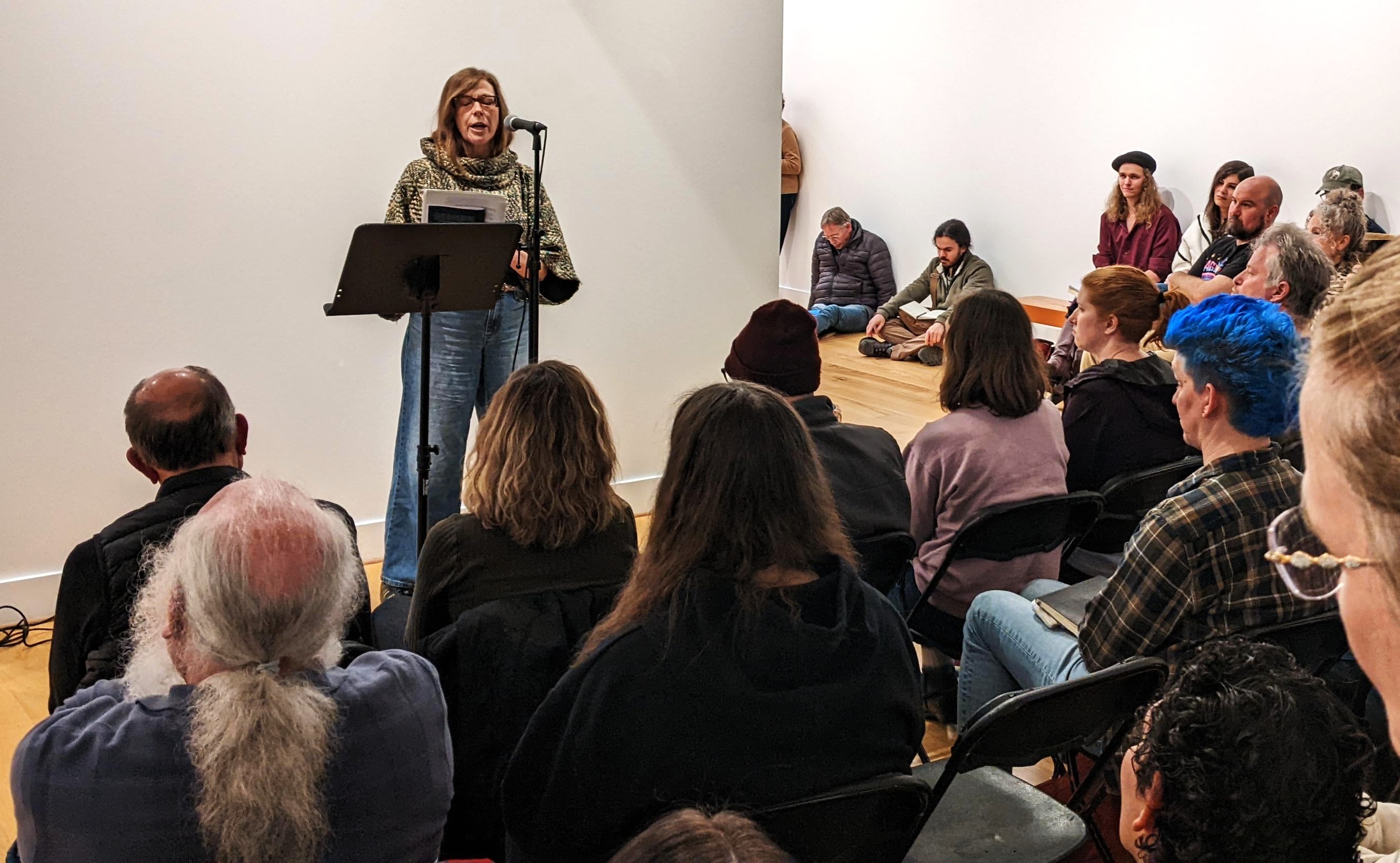
for Renee Nicole Macklin Good at Art At The Cave on January 8, 2026
Our featured reader, Laura Esther Sciortino, included a poem for Renee in her set:
SHE DID NOT HAVE TO
In Honor of Renee Nicole Macklin Good
By Laura Esther Sciortino
With blue and white stuffed animals squished in her car’s glovebox and the kind of courage about which a better poem than this should be written, Renee Nicole Macklin Good was doing something she did not have to do. She cannot tell us herself — because she is dead — but I imagine that it seemed like the least she could do. I imagine that with her son safely dropped off at school and her fair-colored skin, it seemed like the least she could do. Renee Nicole Macklin Good did not have to be good and neither do you. You do not have to be good. Mary Oliver once wrote a poem that begins with this truth. It’s a fan favorite. You probably know it. Meanwhile the world goes on, and the wild geese are heading home. If Mary were here, I imagine she’d tell me to pay attention. It’s the least I can do. Being good and doing good are not the same thing. They can be discrete. Poets do not choose their words carelessly.
Today I write to honor the good that one woman did not have to do. Renee Nicole Macklin Good was a poet herself, a writer, a self-described “shitty guitar strummer,” a wife and a mother of three: a 12-year-old son, a 15-year-old daughter, a six-year-old son. I imagine Good in her kitchen yesterday morning before we knew her face or her name. She’s making breakfast for her youngest before taking him to school, not thinking it’s the least she can do, not thinking of doing or not doing, just feeding her child, just feeding her kin. On this morning like all others, breakfast doesn’t make itself. It starts with getting out of bed in the morning, like every morning, when a mother might like to keep sleeping, might not want to wake the hell up, might want to roll over. Her morning kept going and then we come to the turn in the poem that none of us want and is the least we can do.
Can you imagine the ice-cold blood in her surviving wife’s veins, their son in her arms, and how this isn’t even close to the least she can do? How this is monumentally more than she can bear to do? How she may never want to let go of their son again, after this, because how could you, after this, and meanwhile, the world goes on, and meanwhile the wild geese are heading home, and meanwhile, as her wife Renee once wrote in a poem, maybe there in-between my pancreas & large intestine is the piddly brook of my soul.
Laura Esther Sciortino
I shared Wang Ping‘s “Tsunami Chant II,” which she had posted on her Facebook page that afternoon. I post the poem here with her permission:
One drop of water is not much. One wave is not much. One poem can’t topple the mountain. But a thousand droplets, ten thousand waves, a hundred thousand poems, can change the world.
Tsunami Chant II
Pity the nation that has lost its soul.
Pity the nation that executes our poet in the public eye,
That kills our people in broad daylight.
Pity the nation that lets the innocent bleed to death,
That blocks doctors and ambulances from rescue,
That shrugs, “I don’t care!”
Pity the nation that no longer honors pilgrim feet,
That turns its fruited plain into a killing ground,
That darkens its spacious skies with toxic fumes.
Pity the nation that smothers the Lady with a black mask,
That poisons its purple mountain majesties with hate, lies, murder.
Pity the nation that has lost its path to tomorrow,
That seizes islands and kidnaps presidents
For the crime of sitting atop the world’s richest minerals.
Pity the nation where the death threshold falls so low,
Where icy streets are littered with fear, gas, shattered dreams,
Where one percent owns a third of the country’s wealth,
Where children are starved to feed a few greedy men.
Pity the nation of 朱门酒肉臭,路有冻死骨—
A living image of Du Fu’s poem:
Behind the red gates, wine and meat spoil;
On the streets lie the bones of the frozen dead.
So thin the line between splendor and misery;
My sorrow is too deep for words.
It’s too close to home to hide and be quiet.
It’s too real to pretend it’s just a bad dream.
It’s time we speak, all poets of America.
It’s time we stand, all brave hearts of America.
Let us build a great wall of truth and beauty
With our conscience, our flesh and soul, our poetry.
Let us stop this landslide from the alabaster mountain
Before it sinks into the abyss of darkness.
We are all Renee.
We’re all Good people on earth.
We shall not let Her vanish into the thin ice.
We shall chant till we become one tsunami:
We care.
We care.
We care.
Wang Ping
Albert Haley is a member of our Ghost Town Poetry family who frequently shares anti-fascist poems at the event:
On an Icy Street in Minneapolis in the Wintertime
by Albert Haley
Who was the U.S. citizen Renee Nicole Good?
A 37-year-old woman who was doubly good.
First, her surname. Lovely.
Secondly, everyone testified to her kindness
towards all she met,
and there are the three children that she, a single,
mostly stay at home mom, fed, loved, and hugged.
What else do we know about this person
whom we’re now compelled to speak of past tense?
That she’d moved last year from Kansas City
to the North Star State.
That she lived only blocks away from where whistles blew,
car horns sounded, putting out the alarm
that ICE was on the icy streets doing their cold-hearted thing.
So she drove out in her SUV,
trying to protect her neighbors
from the masked men with guns.
She wanted to keep families from being broken up,
allow hard working people to stay at their jobs, show mercy
where some people’s idea of law
says there should never be a morsel.
She was seeking justice, not a bullet
in the face, not bleeding out
into a deployed airbag, not a Good Samaritan
physician forced to stand aside
by the masked men as they breathed
more mayhem and murder and lies into their phones
while bystanders filmed the whole thing going down.
What else?
She was an English major, a self-described poet
who had studied the craft in college, won
an undergrad award for a poem
entitled “On Learning to Dissect Fetal Pigs.”
Though Renee Nicole Good will never write another poem,
I think if she did the poem wouldn’t be about dissecting ICE
or calling her killers and their cosplay commander, Kristi Noem, “pigs.”
That would be too easy, too artless.
Instead, I think her poem might have something
to do with us in this room, all of us poets who perhaps
have not yet gone slipping and sliding
on the iciest of life’s streets, who have never felt the wintertime blast
of violent fascist heat, who never have had to summon the courage
to say with both words and our bodies:
I am Good, I will stay Good, all will know
I’m Good by what I do and what they take away.
Domenique shared Renee Good’s poem “On Learning to Dissect Fetal Pigs,” which received a 2020 Academy of American Poets College Prize.
Also of interest to those following this case:
“Renee Nicole Good Is Murdered” by Cornelius Eady.
“One Brave Word After the Next” by Amber Tamblyn.
If you are disgusted with ICE and its harassment, abuse, and kidnapping of our Latin-American neighbors and friends, please support the SW WA LULAC Rapid Response & Care Team.
 PRINTED MATTER VANCOUVER